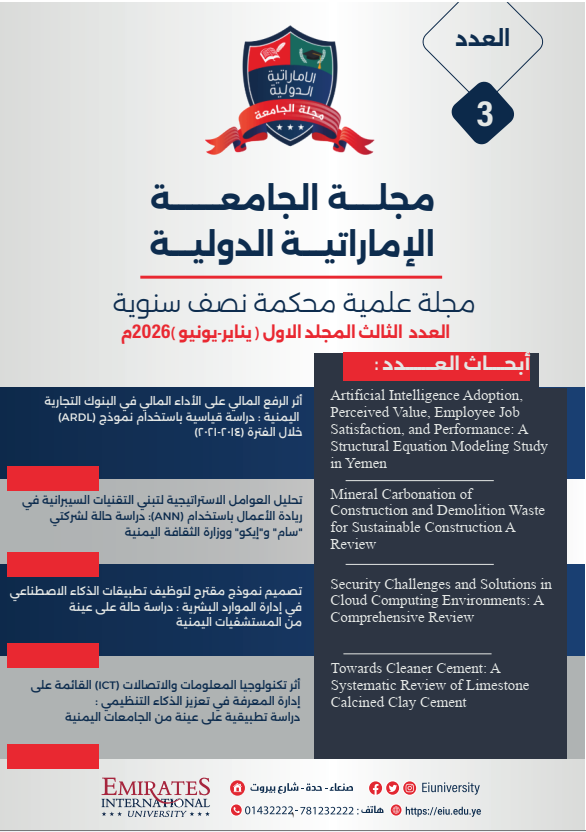
Artificial Intelligence Adoption, Perceived Value, Employee Job Satisfaction, and Performance
A Structural Equation Modeling Study in Yemen
DOI:
https://doi.org/10.64059/eiu.v3i1.92Keywords:
Employee Job Satisfaction, Employee Performance, AI Impact, Structural Equation Modeling, Yemeni EnterprisesAbstract
Given the ongoing political conflict and economic uncertainty in Yemen, Human Resources Management (HRM) has emerged as a crucial research topic for achieving better organizational performance, particularly with the increasing adoption of Artificial Intelligence (AI) technology in the workplace. This study aims to examine whether variables, such as employee perception, expectations, perceived value, and AI adoption influence employee job satisfaction and performance. Through a questionnaire survey yielding 201 valid responses, this study employs the Structural Equation Modeling (SEM) approach to analyze data using Smart-PLS software. Key findings can be summarized as follows: (1) AI adoption facilitates perceived value to be the strongest direct factor affecting employee job satisfaction; (2) Employee job satisfaction contributes to employee performance through employee loyalty; and (3) Employee expectation and perception are the enablers of AI’s impact and job satisfaction, creating a reinforcing cycle. These findings provide insights for policymakers and organizations to recognize the role of investing in AI-enabled HRM systems and their capacity to foster workforce stability and employee performance in uncertain situations.
Downloads
References
Ahmed, M. A. (2012). The Role of Self-esteem and Optimism in Job Satisfaction among Teachers of Private Universities in Bangladesh. Asian Business Review, 1(2), 114–120. https://doi.org/10.18034/abr.v1i2.129
Almosawi, F., Aldoseri, N., & Al-Sartawi, A. (2024). The Impact of Artificial Intelligence Accounting Systems on Workforce Productivity and Job Satisfaction. In A. M. A. Musleh Al-Sartawi, A. S. Aydiner, & M. Kanan (Eds.), Business Analytical Capabilities and Artificial Intelligence-enabled Analytics: Applications and Challenges in the Digital Era, Volume 2 (Vol. 1152, pp. 431–450). Springer. https://doi.org/10.1007/978-3-031-57242-5_35
Bussing, A., Bissels, T., Fuchs, V., & Perrari, K.-M. (1999). A Dynamic Model of Work Satisfaction: Qualitative Approaches. Human Relations, 52(8), 999–1028. https://doi.org/10.1177/001872679905200802
Chuang, Y.-T., Chiang, H.-L., & Lin, A.-P. (2025). Insights from the Job Demands–Resources Model: AI's dual impact on employees’ work and life well-being. International Journal of Information Management, 83, 102887. https://doi.org/10.1016/j.ijinfomgt.2025.102887
Goretzki, L., Reuter, M., Sandberg, J., & Thulin, G. (2022). Making sense of employee satisfaction measurement – A technological frames of reference perspective. The British Accounting Review, 54(1), 101032. https://doi.org/10.1016/j.bar.2021.101032
Hee, O. C., Yan, L. H., Rizal, A. M., Kowang, T. O., & Fei, G. C. (2018). Factors Influencing Employee Job Satisfaction: A Conceptual Analysis. International Journal of Academic Research in Business and Social Sciences, 8(6), 331–340. https://doi.org/10.6007/IJARBSS/v8-i6/4207
Hoppock, R. (1935). Job Satisfaction. Harper & Brothers.
Kashyap, H., & Goyal, A. (2018). A Study on Factors Influencing Employee Job Satisfaction in Hotel Industry: A Study with Reference to Hotels in Jaipur. In New Dimensions in E-Governance (pp. 161–168). INSPIRA.
Katzell, R. A. (1964). Personal Values, Job Satisfaction, and Job Behavior. In H. Borow (Ed.), Man in a World of Work (pp. 341–363). Houghton Mifflin.
Li, Y., & Chen, J. (2021). 员工满意度指数及测量工具研究进展 [Research Progress of Employee Satisfaction Index and Measurement Tools]. 产业与科技论坛, 20(9), 53–55.
Li, Y., & Deng, L. (2019). 制造业技能员工工作满意度影响因素及影响机制研究——以某精工装备公司为例 [Study on the Influencing Factors and Mechanism of Manufacturing Skilled Employees' Job Satisfaction: Taking a Precision Equipment Company as an Example]. Journal of Human Resource Management, 7(3), 89–94.
Ning, L. (2024). 高新技术类企业员工工作满意度影响因素与应对策略 [Influencing Factors and Coping Strategies of Employee Job Satisfaction in High-Tech Enterprises]. 乡镇企业导报(7), 237–239.
Porter, L. W., & Lawler, E. E. (1968). What Job Attitudes Tell About Motivation. Harvard Business Review, 46(1), 118–126.
Riyanto, S. (2020). Factors Influencing Employee Job Satisfaction. International Journal of Current Research, 12(1), 9412–9418. https://doi.org/10.24941/ijcr.37624.01.2020
Robbins, S. P. (1996). Perilaku Organisasi: Konsep, Kontroversi, Aplikasi (Indonesian edition ed., Vol. 2). PT Prenhallindo.
Wang, Q. (2020). 新生代员工工作满意度的影响因素及对策研究 [Research on the Factors Influencing the Job Satisfaction of the New Generation Employees and Countermeasures]. 财经界(22), 56–57.
Wu, W., Yang, Y., Yang, L., Su, L., & Chen, Z. (2025). The Inverted U-Shaped Relationship Between AI and Job Satisfaction: Empirical Evidence from China’s CLDS Microdata. Emerging Markets Finance and Trade, 62(8), 2554–2569. https://doi.org/10.1080/1540496x.2025.2548427
Xu, L., He, J., & Ren, L. (2021). 沪宁4家三级甲等公立医院后勤员工工作满意度及其影响因素 [Job Satisfaction and Its Influencing Factors Among Logistics Employees in Four Tertiary Grade-A Public Hospitals in Shanghai and Nanjing]. 中国卫生资源, 24(5), 592–596. https://doi.org/10.13688/j.cnki.chr.2021.201045
Zhang, J. (2020). Z房地产公司员工工作满意度的测量与改善研究 [Master's thesis, China University of Mining and Technology]. China National Knowledge Infrastructure (CNKI).
Downloads
Published
Issue
Section
Categories
License
Copyright (c) 2026 the Author(s).

This work is licensed under a Creative Commons Attribution 4.0 International License.