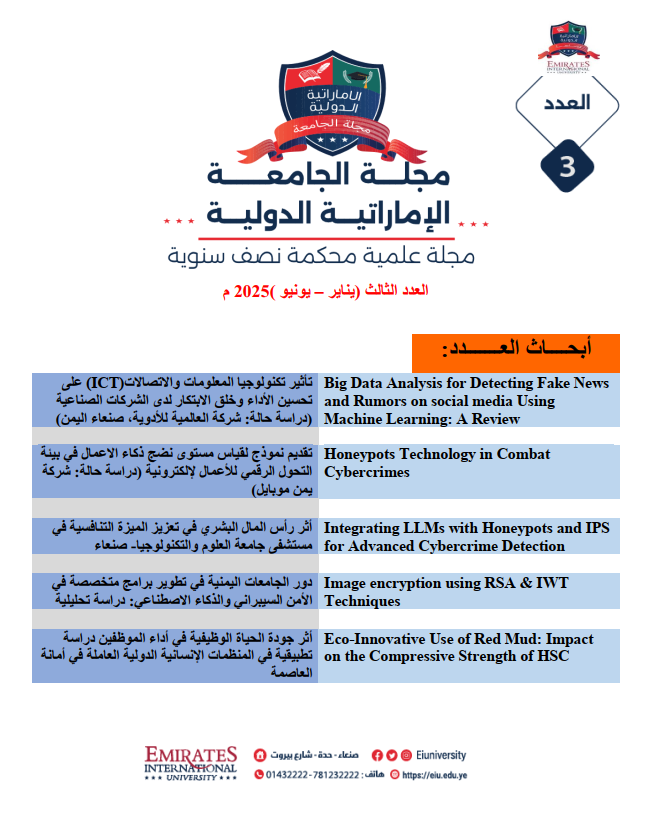
Provide a model for measuring the level of business intelligence ripening in the digital transformation environment for electronic business
Case study Yemen Mobile Company
DOI:
https://doi.org/10.64059/eiu.v3i3.77Keywords:
Maturity, Internet Service Providers, Electronic Business, Business IntelligenceAbstract
This research aims to provide a model to measure the level of business intelligence ripening in the environment of the digital transformation of the electronic business of companies that provide Internet services, which was conducted using the qualitative curriculum based on the apparent approach. The number of participants in this study reached 100 specialists, experts and electronic business managers who worked in the field of providing Internet services in Yemen Mobile, who were chosen using the maximum discrimination method. The data was collected through in -depth and semi -organized interviews and is analyzed using the Clayees method. The results are classified into five levels of business intelligence using the Delphi style (level 1: basic maturity, level 2: frequent maturity, level 3: specified maturity, level 4: orbiting, level 5: improved maturity). After that, a model that includes 33 dimensions and 232 indicators are designed in research literature, where the dimensions and indicators were chosen according to the researcher's opinion and the approval of experts. The five levels of business intelligence are finally distributed and analyzed using the analysis of the confirmation factors in the Smartpls program, the form of support for the model.
References
Ahmed, F., & Capretz, L. F. (2021). A business maturity model of software product line engineering. Information Systems Frontiers, 13(4), 543–560.
Al-Ayed, S. (2022). The impact of e-commerce drivers on e-customer loyalty: Evidence from KSA. International Journal of Data and Network Science, 6(1), 73–80.
Basile, L. J., Carbonara, N., Pellegrino, R., & Panniello, U. (2022). Business intelligence in the healthcare industry: The utilization of a data-driven approach to support clinical decision making. Technovation, Article 102482.
Bosilj Vuksic, V., Pejic Bach, M., Grubljesic, T., Jaklic, J., & Stjepic, A. M. (2017). The role of alignment for the impact of business intelligence maturity on business process performance in Croatian and Slovenian companies. Proceedings of the 40th International Convention on Information and Communication Technology, Electronics and Microelectronics (MIPRO), 1587–1592. Opatija, Croatia.
Brichni, M., Dupuy-Chessa, S., Gzara, L., Mandran, N., & Jeannet, C. (2017). BI4BI: A continuous evaluation system for Business Intelligence systems. Expert Systems with Applications, 76, 97–112.
Broekhuizen, T. L., Broekhuis, M., Gijsenberg, M. J., & Wieringa, J. E. (2021). Introduction to the special issue – Digital business models: A multidisciplinary and multi-stakeholder perspective. Journal of Business Research, 122, 847–852.
Brzozowski, A., & Bubel, D. (2022). E-business as a new trend in the economy. Procedia Computer Science, 65, 1095–1104. (Original conference year 2015.)
Cardoso, E., & Su, X. (2022). Designing a Business Intelligence and Analytics maturity model for higher education: A design science approach. Applied Sciences, 12(9), 4625.
Cates, J. E., Gill, S. S., & Zeituny, N. (2022). The Ladder of Business Intelligence (LOBI): A framework for enterprise IT planning and architecture. International Journal of Business Information Systems, 1(1–2), 220–238.
Chaffey, D. (2021). E-business and e-commerce management: Strategy, implementation and practice (5th ed.). Pearson Education Limited.
Chin, W. W. (1998). The partial least squares approach to structural equation modeling. In Modern Methods for Business Research (pp. 295–336). Lawrence Erlbaum Associates.
Cohen, J. (1988). Statistical power analysis for the behavioral sciences (2nd ed.). Lawrence Erlbaum Associates.
Curtis, B., & Alden, J. (2022). Maturity Model du Jour: A recipe for side dishes. BPTrends.
Farshadi, R., Nazemi, E., & Abdolvand, N. (2022). A framework for ranking critical success factors of business intelligence based on enterprise architecture and maturity model. Interdisciplinary Journal of Information, Knowledge & Management, 17.
Fedouaki, F., Okar, C., & Almai, S. El. (2023). A maturity model for Business Intelligence system projects in small and medium-sized enterprises: An empirical investigation. International Journal of Computer Science Issues, 10(6), 61–69.
Fornell, C., & Larcker, D. F. (1981). Evaluating structural equation models with unobservable variables and measurement error. Journal of Marketing Research, 18(1), 39–50.
Garcia, J. (2021). BI maturity and software selection perspectives. Technology Evaluation Center, 1–12. Available at: https://www.technologyevaluation.com
Gartner. (2022). Gartner Executive Programs CIO Survey. Retrieved June 2022 from https://www.gartner.com
Harmon, P. (2024). Evaluating an organization’s business process maturity. Business Process Trends, 2(3), 1–11.
Henseler, J., Ringle, C. M., & Sinkovics, R. R. (2019). The use of partial least squares path modeling in international marketing. In New Challenges to International Marketing (pp. xx–xx). Emerald Group Publishing.
Hewlett, P. (2022). The HP Business Intelligence Maturity Model. Retrieved April 21, 2009, from http://h71028.www7.hp.com/ERC/downloads/4AA1-5467ENW.pdf
Lahrmann, G., Marx, F., Winter, R., & Wortmann, F. (2020). Business intelligence maturity models: An overview. In Information Technology and Innovation Trends in Organizations: Proceedings of itAIS 2010.
Mkansi, M. (2022). E-business adoption costs and strategies for retail micro businesses. Electronic Commerce Research, 22(4), 1153–1193.
Oghazi, P., Karlsson, S., Hellström, D., Mostaghel, R., & Sattari, S. (2021). From Mars to Venus: Alteration of trust and reputation in online shopping. Journal of Innovation & Knowledge, 6(4), 197–202.
SAS. (2021). Information Evaluation Model. http://www.sas.com/software/iem/
Sawadogo, P., & Darmont, J. (2021). On data lake architectures and metadata management. Journal of Intelligent Information Systems, 56(1), 97–120.
Soluk, J., Miroshnychenko, I., Kammerlander, N., & De Massis, A. (2021). Family influence and digital business model innovation: The enabling role of dynamic capabilities. Entrepreneurship Theory and Practice, 45(4), 867–905.
Sun, Z., Sun, L., & Strang, K. (2018). Big data analytics services for enhancing business intelligence. Journal of Computer Information Systems, 58(2), 162–169.
Tan, C. S., Sim, Y. W., & Yeoh, W. (2021). A maturity model of enterprise business intelligence. Communications of the IBIMA, 2011(417812), 1–11.
Watson, H., Ariyachandra, T., & Matyska, R. J. (2021). Data warehousing stages of growth. Information Systems Management, 18(3), 42–50.
Downloads
Published
Issue
Section
Categories
License
Copyright (c) 2025 the Author(s).

This work is licensed under a Creative Commons Attribution 4.0 International License.
Deprecated: json_decode(): Passing null to parameter #1 ($json) of type string is deprecated in /home/eiuedunetcp/public_html/journals.eiu.edu.ye/plugins/generic/citations/CitationsPlugin.php on line 68