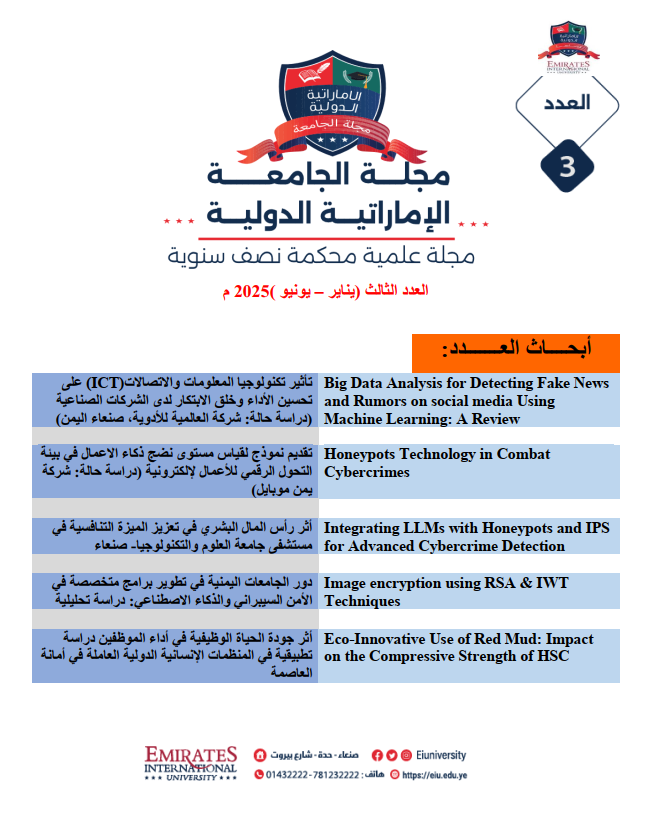
The effect of information and communications technology (ICT) on improving performance and creating innovation among industrial companies
Case Study International Pharmaceutical Company, Sana'a Yemen
DOI:
https://doi.org/10.64059/eiu.v3i3.75Keywords:
ICT Technology, Institutional Performance, Innovation, Global Pharmaceutical CompanyAbstract
The fate of societies has become increasingly linked to technology. It is clear that in such a case, understanding the effects of technology, including ICT technology (ICT), has become very important. It is worth noting that information technology is one of the important environmental factors that seriously affects the position, performance and fate of societies, organizations and individuals. This study aimed to study the impact of ICT technology (ICT) on innovation and performance at the International Medicines Company in Sanaa. The research curriculum is descriptive - survey. The statistical community represents the current study in the employees of the International Pharmaceutical Company, where 172 people were chosen as a sample using the Kurdran format and the simple random sample method. The data collection tool to measure the effects of ICT technology (ICT) as an assistant to innovation factor on industrial companies' performance is the questionnaire. Data analysis was also conducted on two levels of descriptive and inferential statistics. Structural equations modeling was also used using SMARTPLS to verify research hypotheses. Finally, all the research hypotheses were confirmed, and the results showed that information and communications technology has a significant impact on innovation and the company's performance.
Downloads
References
Al Teneiji, T. M., Ahamat, A., Murad, M., & H. A. A. (2022). The mediating role of knowledge management in the relationship between IT capabilities and innovation capabilities. Specialusis Ugdymas.
Gaviria‑Marin, M., Matute‑Vallejo, J., & Baier‑Fuentes, H. (2021). The effect of ICT and higher‑order capabilities on the performance of Ibero‑American SMEs. Computational and Mathematical Organization Theory.
Hintama, A., Maulida, M., & Bustaman, Y. (2021). The impact of innovation capability on product innovation performance: A case study of the manufacturing industry in Indonesia. Conference Series, 3(1), 218–247.
Santoro, G., Vrontis, D., Thrassou, A., & Dezi, L. (2018). The Internet of Things: Building a knowledge management system for open innovation and knowledge management capacity. Technological Forecasting and Social Change, 132, 345–374.
Chege, S. M., Wang, D., & Suntu, S. L. (2023). Impact of information technology innovation on firm performance in Kenya. Information Technology for Development, 12, 312–347.
Langley, D. J., van Doorn, J., Ng, I. C., Stieglitz, S., Lazovik, A., & Boonstra, A. (2022). The Internet of Everything: Smart things and their impact on business models. Journal of Business Research, 111, 823–873.
Cristofaro, M. (2023). E-business evolution: An analysis of mobile applications’ business models. Technology Analysis & Strategic Management, 31, 88–143.
Haaker, T., Ly, P. T. M., Nguyen‑Thanh, N., & Nguyen, H. T. H. (2020). Business model innovation through the application of the Internet of Things: A comparative analysis. Journal of Business Research, 112, 112–132.
Akter, S., Michael, K., Uddin, M. R., McCarthy, G., & Rahman, M. (2020). Transforming business using digital innovations: The application of AI, blockchain, cloud, and data analytics. Annals of Operations Research, 348, 5–34.
Upadhyay, N. (2021). Demystifying blockchain: A critical analysis of challenges, applications, and opportunities. International Journal of Information Management, 74, 114–141.
Del Gaudio, B. L., Porzio, C., Sampagnaro, G., & Verdoliva, V. (2023). How mobile, internet and ICT diffusion affect the banking industry? An empirical analysis. European Management Journal, 34, 315–331.
Zhang, H., Gupta, S., Sun, W., & Zou, Y. (2024). How social‑media‑enabled co‑creation drives business value: The role of organizational learning and social capital. Information & Management, 75, Article 143144.
Ali Qalati, S., Li, W., Ahmed, N., Mirani, M. A., & Khan, A. (2023). Examining the factors affecting SME performance: The mediating role of social media adoption. Sustainability, 13, Article 57.
Marion, T. J., & Fixson, S. K. (2021). The transformation of the innovation process: How digital tools are changing work, collaboration, and organizations in new product development. Journal of Product Innovation Management, 38, 117–141.
Pizzi, S., Corbo, L., & Caputo, A. (2021). Fintech and SMEs sustainable business models: Reflections and considerations for a circular economy. Journal of Cleaner Production, 181, Article 117115.
Kostis, A., & Ritala, P. (2022). Digital artifacts in industrial co‑creation: Using VR technology to bridge the provider‑customer boundary. California Management Review, 21, 117–145.
Ranta, V., Aarikka‑Stenroos, L., & Väisänen, J. M. (2021). Digital technologies catalyzing business model innovation for a circular economy: A multiple case study. Resources, Conservation & Recycling, 124, 147–177.
Eaton, J., Jinkins, D., Tybout, J. R., & Xu, D. (2021). Two‑sided search in international markets (Working Paper No. 14284). National Bureau of Economic Research.
Chege, S. M., & Wang, D. (2022). The influence of technology innovation on SME performance through environmental sustainability practices in Kenya. Technology in Society, 24, Article 114141.
LaBerge, L., O’Toole, C., Schneider, J., & Smaje, K. (2021). How COVID‑19 pushed companies over the technology tipping point and transformed business forever. McKinsey & Company.
Alam, K., Adeyinka, A. A., & Wiesner, R. (2022). Smaller businesses and e‑innovation: A winning combination in Australia. Journal of Business Strategy, 41, 34–48.
Zhou, Q., Gao, P., & Chimhowu, A. (2021). ICTs in the transformation of rural enterprises in China: A multi‑layer perspective. Technological Forecasting & Social Change, 147, 11–13.
Barrett, R., Kowalkiewicz, M., & Shahiduzzaman, M. (2022). High growth and technology: Case studies of Queensland firms in the digital economy. Department of Science, Information Technology and Innovation, Queensland Government.
Alexy, O., West, J., Klapper, H., & Reitzig, M. (2022). Surrendering control to gain advantage: Reconciling openness and the resource‑based view of the firm. Strategic Management Journal, 34, 1515–1544.
Davis, P. E., & Bendickson, J. S. (2021). Strategic antecedents of innovation: Variance between small and large firms. Journal of Small Business Management, 74, 45–51.
Donnellan, J., & Rutledge, W. L. (2022). A case for resource‑based view and competitive advantage in banking. Managerial and Decision Economics, 44, 518–535.
Downloads
Published
Issue
Section
Categories
License
Copyright (c) 2025 the Author(s).

This work is licensed under a Creative Commons Attribution 4.0 International License.