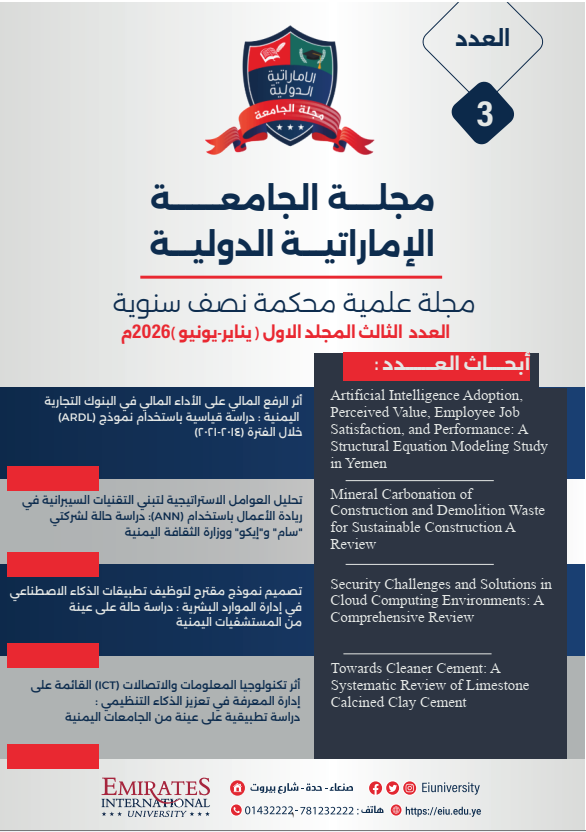
Designing a Proposed Model for Employing Artificial Intelligence Applications in Human Resource Management
A Case Study on a Sample of Yemeni Hospitals
DOI:
https://doi.org/10.64059/eiu.v3i1.94Keywords:
Recruitment, Human Resources, Management, OrganizationalAbstract
This applied study aimed to propose and design a comprehensive model for implementing Artificial Intelligence (AI) in Human Resource Management (HRM) within private organizations. The research adopted an exploratory mixed-methods approach, combining both qualitative and quantitative data. The statistical population comprised scientific documents, 19 qualitative experts chosen via purposive sampling and the saturation principle, and 252 quantitative HR managers selected through convenience sampling from private hospitals in Sana'a, including Saudi German, Arab International, and Azal Hospitals.
Data collection involved semi-structured interviews for the qualitative phase and a researcher-developed questionnaire for the quantitative phase. Qualitative validity and reliability were confirmed through expert opinions, coder consensus, and internal consistency. Quantitative instrument soundness was established using content and construct validity, Cronbach’s alpha, and composite reliability. Data analysis utilized MAXQDA 2022 for thematic qualitative analysis, while SPSS and SmartPLS-v8 were employed for quantitative descriptive and inferential statistics, including one-sample t-tests and confirmatory factor analysis.
The findings revealed that successful AI application in HRM requires key antecedents: organizational strategy, clear vision, supportive culture, adequate resources, and robust infrastructure. The resulting benefits include significantly improved recruitment processes, advanced training development, reduced operational errors, heightened accuracy, and the creation of a strong competitive advantage. Based on these comprehensive results, the proposed AI application model was successfully designed, and its structural validity for practical implementation in private organizations was conclusively proven.
Downloads
References
Akbari, A., & Tahmasebi. (2023). Identifying the applications and requirements of artificial intelligence in the recruitment and hiring process. Scientific Journal, 21(1), 75–88.
Huselid, Mark A. (2018). The science and practice of workforce analytics: Introduction to the HRM special issue. Human Resource Management, 57(3), 679–684. https://doi.org/10.1002/hrm.21916
Rajabi Farjad, H., & Hajiyeh, A. (2022). The impact of electronic human resource management on talent management at the Iranian Space Research Institute. Scientific-Research Quarterly of Standard and Quality Management, 12(2), 102–131.
Emadi, A., Seyed, E., & Hamidi. (2022). Determining the strategic position of the human resource management system in the Ministry of Sports and Youth. Sports Management and Motor Behavior Journal, 18(35), 221–236.
Manouchehri, M., Mohammadizadeh Zeytouni, B., & Darvish Zadeh Belgor, F. (2022). The practical role of artificial intelligence in human resource management in banks. Digital Library.
Mirsalimi, E. S., & Afkaneh, M. (2023). Human resource management policies in addressing opportunities and threats in the use of social networks in organizations. Human Resource Management Research, 4(14).
Heshmdar, A., & Kordi, M. (2022). Examining the effectiveness of artificial intelligence systems in human resource functions. Contemporary Research in Management and Accounting Sciences, 12(4), 16.
Yabanci, Orhan. (2020). From human resource management to intelligent human resource management: a conceptual perspective. Human-Intelligent Systems Integration, 1(2-4), 101–109. https://doi.org/10.1007/s42454-020-00007-x
Downloads
Published
Issue
Section
Categories
License
Copyright (c) 2026 the Author(s).

This work is licensed under a Creative Commons Attribution 4.0 International License.